
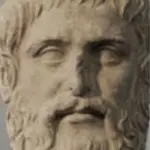
Plotinus
204 – 270
All reality emanates from the One — ascend through intellect and soul to mystical union with the source beyond being.
- Born
- 204, Lycopolis, Egypt (modern Asyut)
- Died
- 270
- Nationality
- Roman (Greek-Egyptian)
- Tradition
- Greek
- School
- Neoplatonism
Character
Mysterious about his origins — refused to discuss his birth, parentage, or homeland, saying he was "ashamed to be in a body." Vegetarian, slept little, never bathed (yet remained healthy until his final illness). Gentle, accessible, beloved by students who lived in his household. Cared for orphans entrusted to him, arbitrated disputes, never made an enemy. His face reportedly shone when he taught. Experienced mystical union with the One four times during the years his student Porphyry knew him. Combined extreme otherworldliness with practical kindness — the philosopher who despised bodies but cared for abandoned children.
Life
Plotinus was born around 204 CE in Lycopolis, Egypt. He refused to speak of his origins, so we know almost nothing of his early life. At twenty-eight, seized by the desire for philosophy, he went to Alexandria and studied with various teachers, finding none satisfactory. Then someone took him to Ammonius Saccas — and "this is the man I was looking for."
He studied with Ammonius for eleven years, bound by an agreement with two fellow students not to divulge the master's teachings. Almost nothing is known of Ammonius, who wrote nothing; Plotinus seems to have kept his vow of silence. Whatever he learned, he made his own.
At thirty-nine, wanting to learn Persian and Indian philosophy, he joined Emperor Gordian III's military expedition against Persia. The campaign failed; Gordian was killed; Plotinus barely escaped to Antioch. He abandoned his Eastern quest and went to Rome instead.
At forty, he began teaching in Rome, attracting a circle of devoted students who became family. His household included orphans, widows, and seekers. For ten years, he taught only orally, honoring his promise to Ammonius. Then, at fifty, he began writing — short treatises, never revised, responding to questions raised in discussion.
His student Porphyry later organized these treatises into six groups of nine: the Enneads ("Nines"). They're not systematic but exploratory — Plotinus thinking on paper, circling the same questions from different angles. The style is dense, often obscure, sometimes ecstatic.
Emperor Gallienus and his wife admired Plotinus. He proposed founding "Platonopolis" — a city governed by Plato's Laws — in Campania. The emperor nearly agreed; courtiers blocked it. The philosopher-city died in committee.
His final years brought illness. The disease — possibly leprosy or tuberculosis — drove friends away; only Porphyry remained for a time, then left for Sicily on Plotinus's advice, to recover from depression. Plotinus retreated to a friend's estate in Campania and died there in 270 CE, aged sixty-six. The physician who had abandoned him arrived at the end. Plotinus's last words were his philosophy compressed: "I am trying to give back the divine in me to the divine in all."
A story about him
A painter wanted to make Plotinus's portrait. Plotinus refused: "Why should I leave an image of an image?" The body is already a shadow of the soul; a painting would be a shadow of a shadow, twice removed from reality. His student Amelius persisted, attending lectures and memorizing Plotinus's features, then directing the painter from memory. The portrait was made without the subject's knowledge — philosophy tricked into preserving what it despised.
How he died
Died at a friend's estate in Campania, alone except for a physician, from a painful illness (possibly leprosy or tuberculosis); his last words were to the physician who arrived too late
Last words
I am trying to give back the divine in me to the divine in all.
Common misconceptions
Plotinus wasn't anti-matter in a Gnostic sense — he argued vigorously against Gnostics who despised the material world. Matter is the lowest emanation of the One, not an evil counter-principle. He wasn't simply repeating Plato; Neoplatonism transforms Plato significantly, especially through the concept of emanation. He wasn't coldly intellectual — his mysticism was warm, his ethics practical, his household full of people he cared for. And his "One beyond being" isn't nothing; it's super-abundant reality that overflows into all existence.
The philosophy
Plotinus's system begins with the One (to hen) — absolute unity, the source of all existence, beyond being, beyond thought, beyond description. The One doesn't create deliberately; it emanates — overflows from superabundance, like the sun radiating light without losing anything.
From the One emanates Intellect (nous) — divine mind contemplating the Forms. Intellect is being and thought unified: to think is to be, to be is to be thought. Here duality first appears — thinker and thought — but they're identical in Intellect.
From Intellect emanates Soul (psyche) — which bridges the intelligible and sensible worlds. Soul generates time and governs the cosmos. Individual souls are portions of World Soul, descended into bodies but retaining connection to their source. We are not bodies that have souls; we are souls that have bodies.
Matter is the final emanation — not evil, but the farthest point from the One, almost non-being. The sensible world is beautiful because Soul shapes matter according to Forms. Gnostics who despise the cosmos are ungrateful children despising their mother.
The human task is return — retracing emanation's path back to the source. Through ethics, we purify the soul of attachment to body. Through dialectic, we train the mind to think the Forms. Through contemplation, we unite with Intellect. And finally, in rare moments of mystical vision, we touch the One — not knowing it but becoming one with it. In that moment, duality disappears. "Then the soul neither sees, nor distinguishes by seeing, nor imagines that there are two, but has become another and is no longer itself."
This is not annihilation but plenitude — the drop returning to the ocean it never really left. The One is always available; we're always already united with it. What seems like ascent is really recognition. What seems like achievement is really letting go.
Philosophy for Plotinus is not academic. It's the work of salvation. The Enneads are a ladder; the point is to climb, then kick the ladder away.
The tension he worked inside
Created Neoplatonism — which claimed to be simply Platonism but was a revolutionary synthesis of Plato, Aristotle, and Stoic elements with mystical ascent. He broke the rationalist container by insisting that the highest reality transcends thought itself. The One is beyond being, beyond intellect — reached only by a leap beyond reason. Philosophy culminates in its own overcoming.
Put another way
Imagine a fountain whose water overflows into a series of basins. The source never diminishes; each basin receives and passes on what it can. The highest basin is perfectly still, perfectly clear — that's Intellect. The next is rippled with motion — that's Soul. The lowest is muddy, almost stagnant — that's matter. Now imagine you're a drop in the lowest basin, forgetting you came from the source. Philosophy is remembering. Mysticism is tracing yourself back up through the basins until you dissolve into the spring itself — which you never actually left.
Lasting influence
Neoplatonism dominated late ancient philosophy and shaped medieval theology profoundly. Augustine converted partly through reading Plotinus; the Confessions are Neoplatonic Christianity. Pseudo-Dionysius transmitted Plotinian mysticism to the medieval West. Islamic philosophy absorbed Neoplatonism through texts falsely attributed to Aristotle. Jewish Kabbalah's sefirot resemble emanation. Renaissance Florence's Platonism was really Plotinus. The Cambridge Platonists revived him against Hobbes's materialism. German Idealism, especially Schelling, drew deeply on him. When anyone speaks of mystical union, transcendent oneness, or the soul's return to its source, Plotinus is usually in the background.
Why it still matters
Plotinus offers a sophisticated alternative to both materialism and conventional theism. His One is not a creator-God but an impersonal source beyond being. This appeals to those seeking spirituality without religion. His account of consciousness as fundamentally unified, not fragmented, challenges materialist reductions. His environmental ethics — the cosmos is beautiful, valuable, ensouled — grounds ecological concern. And his phenomenology of mystical experience remains the most careful philosophical account available. When secular philosophers engage with mysticism seriously, they often end up engaging with Plotinus.
East and West
The parallels with Advaita Vedanta are striking: Brahman (the One) beyond being, the world as emanation not creation, the self's identity with ultimate reality, liberation through knowledge. Plotinus reportedly wanted to study Indian philosophy; perhaps the currents met. Buddhist emptiness differs — Nagarjuna denies the foundational One Plotinus affirms — but both traditions see ordinary reality as dependent and point toward what transcends concepts. Daoist formlessness resonates with the One beyond description. And Meister Eckhart's Godhead beyond God, Sufi fana (annihilation in God), and Kabbalistic Ein Sof (the Infinite) all echo Plotinian structures. The philosopher at Alexandria became the West's teacher of Eastern-sounding metaphysics.
Works
Enneads
Fifty-four treatises organized by Porphyry into six groups of nine (hence "Enneads"). Covering ethics, physics, cosmology, psychology, and metaphysics — but really one extended meditation on the soul's ascent to the One. Dense, unsystematic, sometimes rhapsodic. The founding text of Neoplatonism, shaping a thousand years of Western thought.
Ennead I — Ethics and Aesthetics
On beauty, virtue, happiness, and the soul's care — the most accessible introduction
Ennead V — The Three Hypostases
On the One, Intellect, and Soul — the metaphysical core of Plotinus's system
Ennead VI.9 — On the Good, or the One
Plotinus's most sustained treatment of the One and mystical union — the summit of his thought
Ennead II.9 — Against the Gnostics
Polemic defending the goodness of the cosmos against those who despise it
Where to start
Start with Ennead I.6 "On Beauty" — it's short, accessible, and contains the method and goal of Plotinian philosophy. Then try V.1 "On the Three Primary Hypostases." A.H. Armstrong's Loeb translation is scholarly; Stephen MacKenna's is poetic.
The surprising bit
Plotinus wrote practical treatises on ethical problems: on suicide (against it), on astrology (partly critical), on happiness (virtue suffices). The mystic who longed for union with the One also gave concrete advice on living. The system is cosmic; the application is human.
In his own words
The One is all things and no one of them; the source of all things is not all things.
Never did eye see the sun unless it had first become sun-like, and never can the soul have vision of the First Beauty unless itself be beautiful.
Withdraw into yourself and look. If you do not find yourself beautiful yet, act as does the creator of a statue: cut away, smooth, polish, until you have made yourself beautiful.
Connections
- Responds to
- Plato, AristotlePlato (profoundly), Aristotle, Stoics, Ammonius Saccas, Gnostics (critically)
- Influenced
- Meister EckhartPorphyry, Iamblichus, Proclus, Augustine, Pseudo-Dionysius, Islamic Neoplatonism, Eckhart, Cambridge Platonists
- Argued against
- Gnostics, Epicureans, materialists, Aristotelian category theory (partly)
The verdict
The philosopher of emanation and return. Built a ladder from matter to the One — then showed how to dissolve into the source.